
When Obedience Makes Life Harder
What Exodus 5 Taught Me About Calling, Discernment, and Leadership
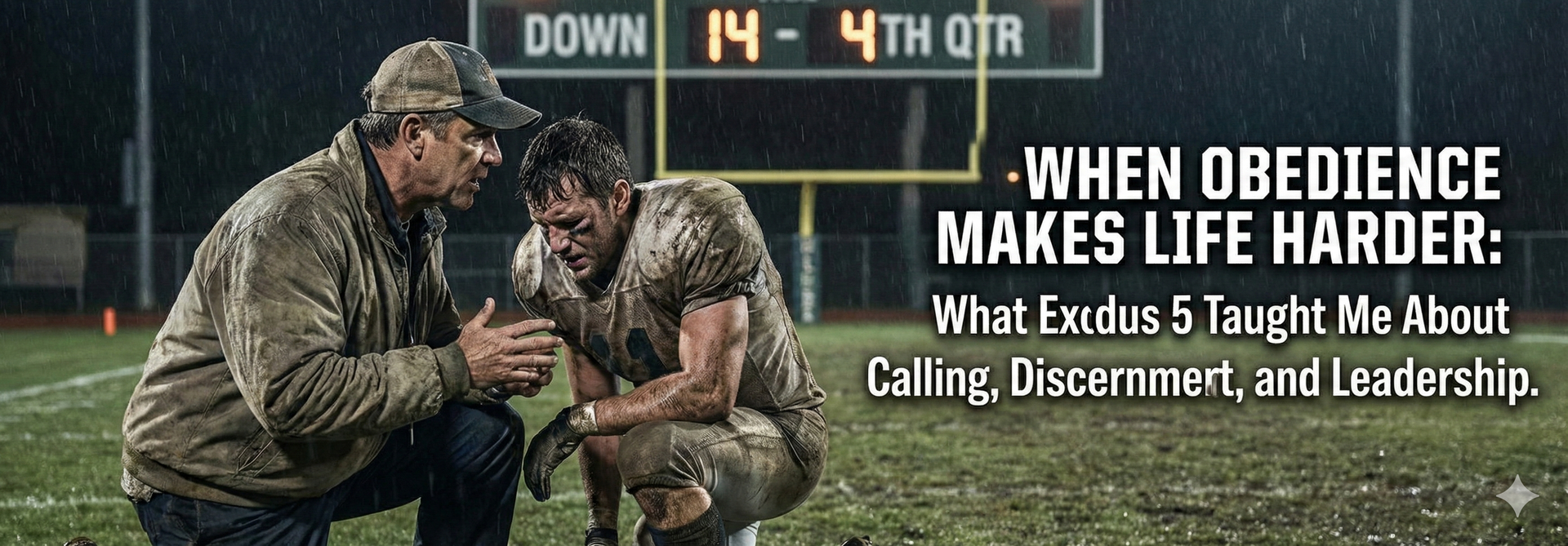
Exodus 5 is one of those chapters you can read a hundred times and suddenly see something new because you’ve lived it. Moses obeys God. He marches into Pharaoh’s court. He delivers the message exactly the way God told him to.
And instead of the situation improving, everything collapses. Pharaoh punishes the people. The people blame Moses.
And Moses turns around and says to God, in pure honesty:
“Lord, why have You brought harm to this people? Why did You ever send me? Ever since I came to Pharaoh to speak in Your name, he has done harm to this people, and You have not delivered Your people at all.” Exodus 5:22–23
It’s raw. It’s frustrated. It’s very human. And honestly? It sounds like most of us in leadership at one point or another.
But here’s the part that always grabs me: God already told Moses this would happen.
Back in Exodus 3 and 4, God said:
- Pharaoh’s heart will be hardened
- He will not let you go at first
- This will take multiple confrontations
Moses didn’t misunderstand the instructions. He didn’t forget the plan. He didn’t need a theological refresher. He just wasn’t emotionally prepared for obedience to backfire.
Chuck Swindoll once wrote, “Moses wasn’t doubting God’s word. He was discovering the cost of following it.”
And that’s exactly what’s happening here.
Hearing God’s will is one thing. Living through it is another.
Moses expected spiritual fireworks… and instead he got political fallout.
He expected resistance… but not rejection from his own people.
He expected God to move… and instead God let things get worse first.
This is the moment where calling collides with reality. And every leader eventually lives this moment.
Why didn’t Moses remind the people of God’s plan? This always bothered me too.
Moses never says,
“Don’t panic. God told me this would happen. It’s part of the plan.”
Instead, he stands there taking all the heat.
Here’s why:
1. God didn’t tell Moses to explain that part to the people.
God gave Moses specific talking points:
- God hears
- God sees
- God will deliver
- Go with the elders to Pharaoh
But God never said, “Tell Israel the process will be slow and painful at first.” So Moses wasn’t hiding anything.
He was simply obedient to what God actually told him to communicate.
2. Israel lacked the emotional capacity for the “long game.”
These were crushed, exhausted, traumatized slaves.
“Hey everyone, this will get worse before it gets better” wasn’t going to help them.
Leadership often requires carrying the parts God shows you that others aren’t ready to hear. God gives leaders portions of the plan the people aren’t ready to carry yet.
- That’s leadership.
- That’s weight.
- That’s why Moses stands alone here.
So why does the Bible never mention Moses “remembering” God’s warning?
Because the point is not mental recall. The point is spiritual formation.
This moment shapes Moses in three ways:
1. God teaches Moses that obedience does not guarantee smooth results.
Tozer said,
“It is doubtful God can use a man greatly until He has hurt him deeply.”
This is Moses’ hurt.
2. God teaches Israel that salvation belongs to Him, not Moses.
If Pharaoh said yes on attempt one, Israel would follow Moses, not the Lord.
God isn’t building a hero. He’s building dependence.
3. God ensures deliverance will be unmistakably supernatural.
Human effort won’t get the credit.
The story must end with, “The Lord brought us out,” not, “Moses finally figured it out.”
This moment exposes what’s in Moses and what’s in Israel. God is preparing both.
Where this hits home for us. This isn’t just Moses’ story. It’s ours.
And honestly?
It’s the story of almost every prospective FCA staff member who steps into their calling.
The Prospective Staff Roadblock
I’ve watched this same pattern unfold in our ministry more times than I can count.
A prospective staff member discerns their call.
- They pray.
- They listen.
- They get confirmation from people who love them and hear from God.
- It all lines up beautifully.
Everyone is excited. We’re excited.
It feels like God is moving a chess piece into its spot.
Then they step onto the donor ministry journey.
They start sharing the vision.
They ask people to join them financially or prayerfully.
They’re full of faith… just like Moses walking into Pharaoh’s court.
But instead of excitement, they get hesitation.
Instead of support, they get “not right now.”
People ghost them. People dodge the question.
People admire the calling but won’t join the mission.
They talk to 10 or 15 people — and no one partners.
And the same questions Moses asked start flooding their mind:
“Lord, did I hear You right?”
“If You called me to this, why is it so hard?”
“Why is obedience making everything worse?”
And it’s not just them wrestling.
It’s us too — the leaders who have prayed for years for staff to fill these roles.
“God, everything aligned. It was confirmed in every direction. So why is nothing moving?”
And here’s the truth that every prospective staff member eventually discovers:
- Every calling comes with a Pharaoh.
- Every assignment comes with resistance.
- And every leader faces a moment where obedience feels like failure.
This roadblock hits early for some, late for others, and smack in the middle for many. It’s not proof they misheard God. It’s proof God is forming them.
The Leadership Lesson
Exodus 5 shows us something we all need to remember:
You can be exactly where God wants you… and still feel like everything is falling apart.
Obedience doesn’t guarantee applause. Sometimes it guarantees pressure.
But pressure doesn’t mean you’re wrong. Pressure means you’re being shaped.
You’re being prepared for the weight of the assignment, not punished for saying yes to it.
Moses needed to learn to lead under blame, disappointment, and confusion.
Prospective staff need to learn to stand when their calling isn’t being validated yet.
Leaders in business, coaching, ministry, and family need to learn the same thing:
God’s promise and God’s timing rarely arrive together.
Faith lives in the gap between the two.
And that gap is where God forges leaders.
If you’re in that gap right now…
- You’re not forgotten.
- You’re not off course.
- You’re not disqualified.
- You’re not alone.
Sometimes things getting harder is the confirmation — not the contradiction — that God is moving.
But let me offer a few practical steps if you’re feeling the weight of your own Exodus 5:
1. Go to God with honesty, not performance.
Moses didn’t pretend. He didn’t pray polite.
He brought his frustration to God, not away from Him.
Do that. Say the real thing, not the cleaned-up version.
2. Remember what God did say, not what you assumed He said.
Moses wasn’t wrong — he just expected the deliverance to be immediate.
Check your expectations. Go back to what God actually promised you.
3. Don’t interpret resistance as rejection.
Sometimes the pushback is proof you’re standing in the right place.
Pharaoh’s “no” wasn’t the end. It was the beginning.
4. Bring a trusted person into the struggle.
Don’t wrestle alone. Sometimes you need someone to help you see where God is working when your emotions are too loud to notice.
5. Keep stepping in the direction God last confirmed.
When you’re confused, go back to the last clear instruction.
That’s where you stand until God speaks again.
A final thought for leaders, coaches, and prospective FCA staff
If you’re walking through a season where obedience is making life harder, don’t let the weight fool you. This is not the moment to back away.
This is the moment God is doing His quiet work — the deep work — inside you.
- He’s forming courage.
- He’s forming perseverance.
- He’s forming trust.
- He’s forming leadership that can withstand real pressure.
And just like with Moses, the story doesn’t end in Exodus 5.
The breakthrough comes. The deliverance comes.
The “God did this” moment comes — in a way that gives Him all the glory and grows you into the leader He’s shaping you to be.
- So stay faithful.
- Stay steady.
- Stay honest before the Lord.
- And keep walking in the direction He called you.
You might not see it yet, but the pressure you’re feeling might be the very evidence that God is preparing something far bigger than you imagined.
Go and Grow,
Scot
Are you wondering how you can make difference? Maybe Sports Ministry could be a path for you. Click the links below explore.
Volunteer with Battlefield FCA – Help us disciple the next generation.
Become a Monthly Supporter – Fuel the mission that’s changing lives.
Pray with us – Identity in Christ is spiritual warfare. We need covering.
Help Us Spread the Word and Share!